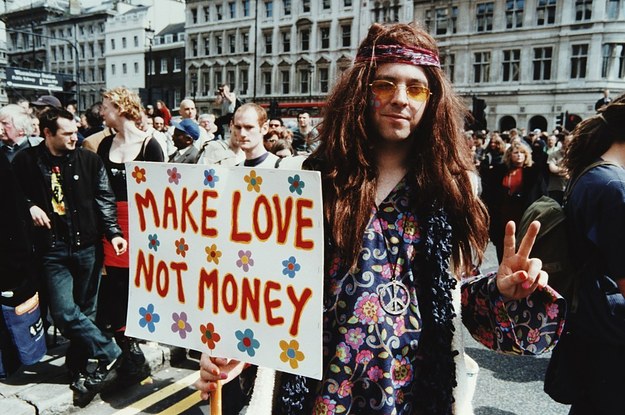
Have you ever noticed how social trends change as new decades unfold? The Hippie Movement of the 1960s became the “Hangover Movement” of the 1970s. All that free love and “we don’t need money…baby…we got love…” rhetoric of the 1960s became the cold reality of the 1970s. No cash in your pocket meant starvation and a park bench. Free Love became Love Child. It also became sexually transmitted disease for some. We learned the party would not last forever. It had to end.
Despite our love of all things LOVE, we learned love didn’t pay the bills and put food on the table. It didn’t end the wars either. We’d find free love wasn’t free at all. With it came responsibility and emotional issues from which we couldn’t escape. The coming of the 1970s was something of a reality check in terms of responsibility when we were forced to become adults. Some of us never grew up – or became exactly what we detested – The Establishment.
Our maturity didn’t happen overnight, but instead in baby steps as our income and stature in the community grew. We found nothing in life is free – someone always pays. We also discovered real money wasn’t so bad after all. It got us all those things we wanted. The hippies of the 1960s became the yuppies – upwardly mobile, mocha-sipping doctors, lawyers, dentists, psychologists, business executives, day traders, real estate developers, politicians, and a whole lot of widespread narcissistic self-absorption. We believed it was all about us.
We had met the enemy – and the enemy was what we became.

According to those with vast knowledge of the subject, the hippies were a sociological group of primarily young people, now elderly, were associated with the enormous counterculture movement of the 1960s – launched here in the United States. We ditched the suit and tie and donned tie-dyed tee shirts and worn-out jeans. The hippie movement spread like wildfire across the globe.
The hippie movement fueled the Generation Gap.
Wikipedia tells us the word “hippie” evolved from the word “hipster” and was used to describe the beatniks of the early 1960s who moved into New York City’s Greenwich Village as well as San Francisco’s Haight-Ashbury district and Chicago’s “Old Town” community. In fact, the word “hippie” was first used by San Francisco writer Michael Fallon in an effort to popularize use of the term in the media. “Hippie” spread far and wide and remains in use today.
Some say the Hippie movement came of the struggles of the 1950s – the Korean War, McCarthyism, Big Brother, The Cold War, The Draft, the Space Race, and the social pressures of the times. Some chose not to get on board with our parents’ beliefs and the “dog-eat-dog” world we bitterly believed they supported. Instead, we checked out.
To the best of my recollection, the Hippie movement began with the Beatniks – young people who embraced the apparent cultural shifts going on in a post-war America. Young people, opposed to everything The Greatest Generation wanted for us, didn’t want any parts of what the generation that fought for our freedom wanted for us. Young people got into the mental escape of drug use and cults.
It didn’t always go well.
The hippie movement turned drug and cult movement spread across society like a plague. Heroin overdoses became epidemic and a curse that remains with us today. In our quest to escape the miseries of reality, we have continued that “escape” decades later only to find out coming off that high the world hasn’t change one bit. The same can be said for alcohol.
The hippie movement, with fluid precision, faded into relative adulthood in the 1970s. Most hippies became responsible adults, had children of their own, and are now running the country. We face huge obstacles and division that are not going away. Until we learn how to unify as a nation and put our country first, it is only going to get worse. The division we face today is nothing new. Opposing factions were hard at it 50-60 years ago. What’s happening now is only the latest chapter.
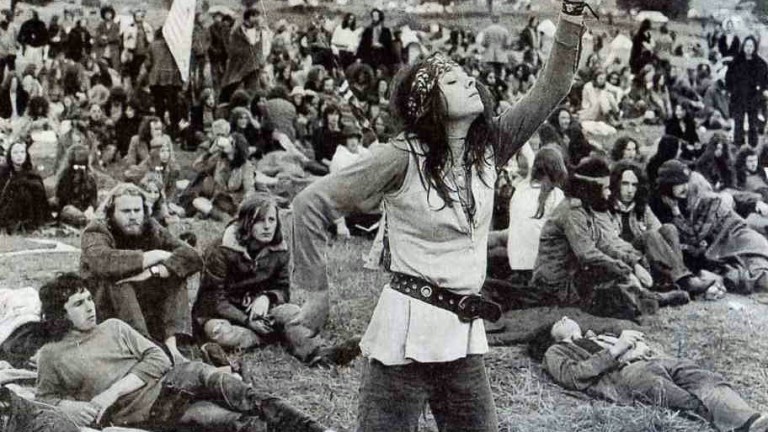
Now me – I was born amid the baby boom in 1956 and became part of the post-hippie movement of the 1970s with bellbottoms, platform shoes, The Partridge Family, and boring lackluster economy cars. We were post-hippie dorkenheimers who liked looking cool at the shopping malls and social events. In truth, we were not cool…but decidedly luke warm. We missed the Woodstock chapter completely and had to settle for the mediocrity of the 1970s – and so it went.
The hippies who came before us were forced to grow up and were handed the torch that is the mess that is the America we live in today. Our parents feared what was to become the country run by boomers. Most were glad they were old enough to never see the divided culture we are today.
Boomers and the generations following us have to keep working toward making us a more perfect union.
 Boomer Journey...