The Sweet Escape of Classic Television

Do you ever find yourself lost in the virtual reality of classic television? I obsess over classic TV and I am an avid watcher. I’ve burned up valuable time watching “The Andy Griffith Show,” “The Dick Van Dyke Show,” “I Dream of Jeannie,” “Mister Ed,” “Dennis the Menace,” “I Love Lucy,” “The Monkees,” “Ozzie & Harriet,” and a host of others – some really awful – but watchable.

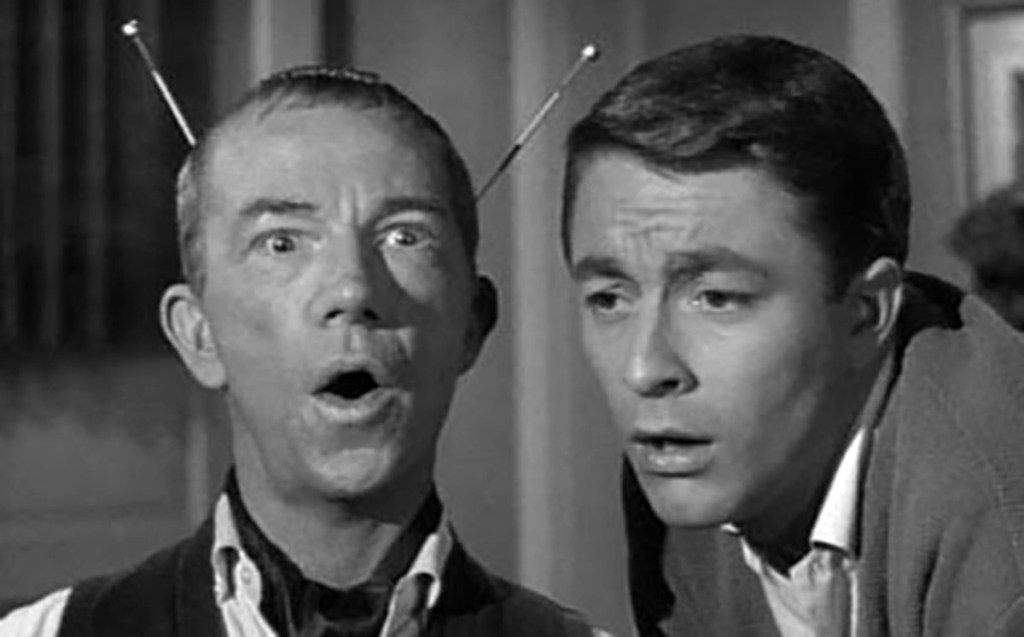
In the past few weeks, I have been overdosing on “My Favorite Martian,” a mid-1960s science fiction TV comedy, which struggled to find an audience and meaningful ratings on two networks in three seasons. I admit to having developed a fondness for Ray Walston and Bill Bixby, who played the Martian (Exigius 1212) and Earthling Tim O’Hara, sharing a loft next door to their attractive yet scatterbrained landlady, Lorelei Brown, (actress Pamela Britton) in suburban Los Angeles.

O’Hara, a roving reporter for the fictional Los Angeles Sun newspaper, was covering an X-15 test flight over the high desert north of Los Angeles when who should crash land from space but “Exigius 1212” (Ray Walston), a Martian anthropologist who nearly collided with the X-15 on a journey to study primitive Earth.

O’Hara winds up being Exigius 1212‘s caretaker on Earth until he can repair his broken spaceship and return to Mars. Because Tim O’ Hara doesn’t know how to explain Exigius 1212‘s presence, he becomes Uncle Martin. The spaceship gets parked in Tim’s garage under lock and key while the two try to keep a bizarre secret.

“My Favorite Martian” struggled in the ratings though it was a good way to spend 30 minutes. Even with a different network in color, it aired just three seasons.

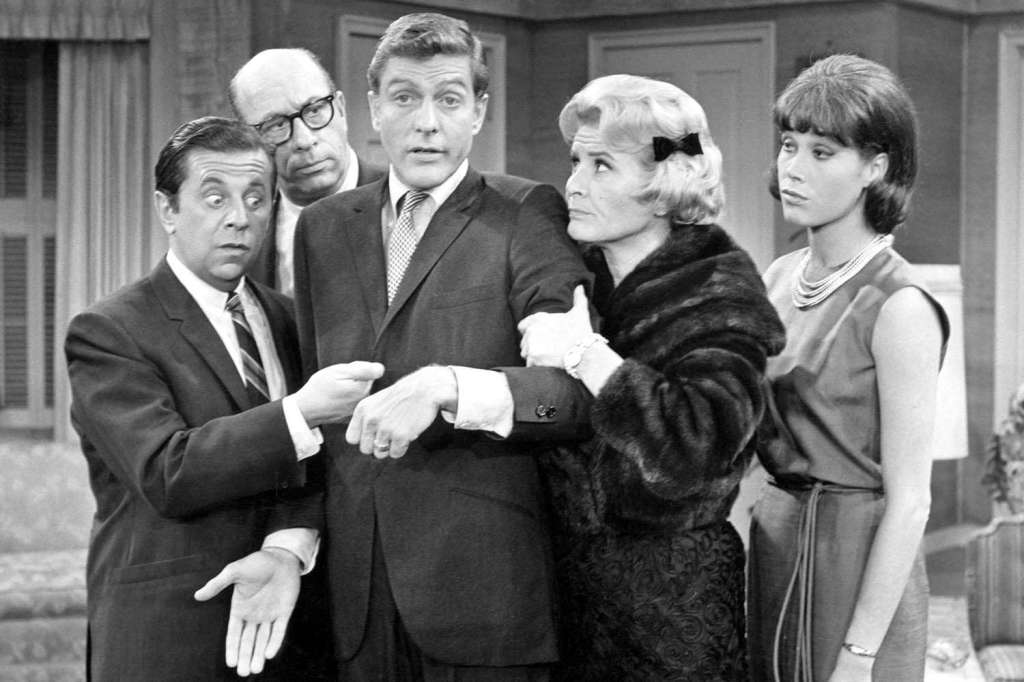
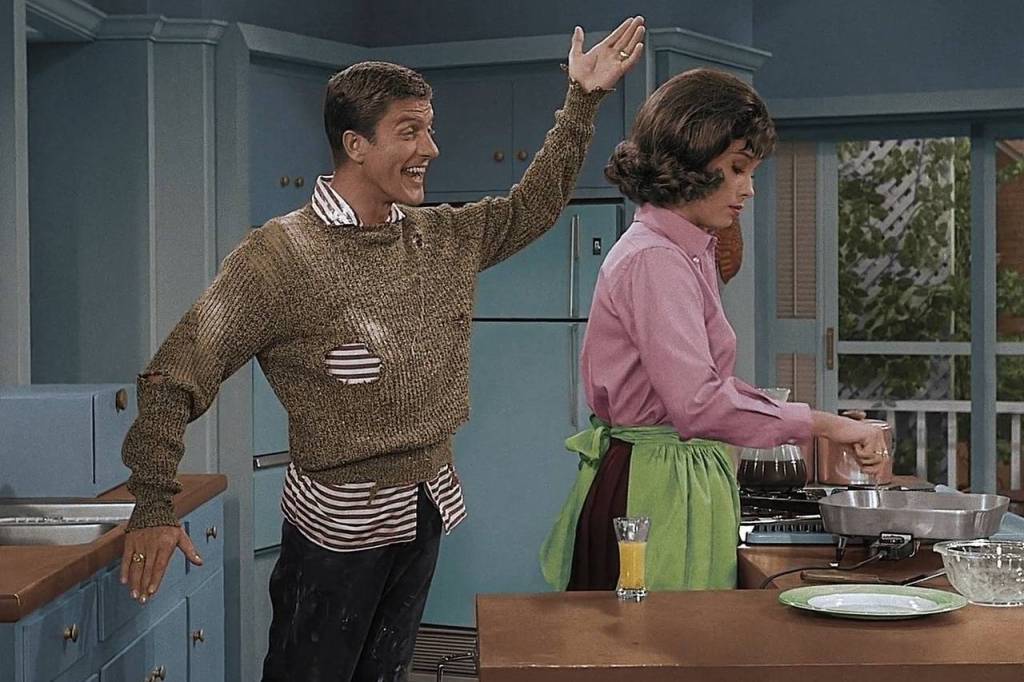
Another obsession is “The Dick Van Dyke Show” which is another periodic television obsession. When I watch, I just can’t get enough of it. Dick Van Dyke, who played Robert Petrie, was a fictional comedy writer created by the late Carl Reiner that first aired on CBS in October of 1961. The show focused on both the home and work life of Rob Petrie, head writer for the “The Alan Brady Show” which was live from New York – yet we never actually saw the show. The one exception being the “Alan Brady Christmas Show” featuring the show’s writers and the Petrie family.

“The Dick Van Dyke Show” would never have been the success it was without the chemistry it had – conception, writer, direction, actors and its cast of characters. One-line comic genius Morey Amsterdam never missed. Even when he flubbed his lines, he always knew how to save a scene. Poor Sally Rogers (Rose Marie) could never land a fella. Mel Cooley (Richard Deacon) never could get Alan Brady’s respect. Meddlesome neighbors, Millie and Jerry Helper (Ann Morgan Guilbert and Jerry Paris) never stopped being meddlesome neighbors. Son Ritchie (Larry Matthews), was always the incredible low maintenance boy.

Alan Brady (Carl Reiner, the show’s creator) was a mystery until he smoothly segued into the show. At first, we saw the back of his head and heard his obnoxiousness. The peak of his performance was “Coast to Coast Big Mouth” when Laurie Petrie went on a game show and accidentally mentioned Alan Brady was bald. The secret was out and both Mary Tyler Moore and Carl Reiner did their best work as comedic actors. Even Reiner couldn’t control his emotions in that historic scene.

Alan Brady will always remain Reiner’s greatest comedic work.

The “Dick Van Dyke Show” would have aired in color in its sixth season had the show continued for the 1966-67 season. Cast and creator elected to wrap while the show was on top, leaving us with five seasons of incredible reruns.


Real Muscle in the Mid-Century

Some 60 years ago when we sang “Get Your Motor Running…” and revved our engines with the roar of V-8 muscle, along with our endless search for adventure, there was the all-American muscle car.

If you remember high school and all that muscle in the parking lot (along with the vice principal), you remember the roar of V-8 power, rubber burning, the bang-shift of a T-10 four-speed, and the art of getting sideways.

I suppose muscle is a matter of perception.

Back in the day, muscle cars maxed out around 350-400 horsepower and were rather crude and void of options. They were generally ordered without air conditioning and nearly always fitted with a four-speed transmission.

Automatics were for wimps.

In more recent times, the 800-horse Dodge Hellcat Challenger, Shelby Mustang, and ZL1 Camaro have passed up these timeless classics in terms of raw power and creature comforts. There has never been a better (or faster) factory muscle car in American automotive history. You drive off the dealer lot and get insane horsepower numbers with air conditioning, full spectrum sound, cruise control, sound deadening, ass-hugging high-back bucket seats, air bags, crush zones and side-impact protection, GPS, back-up camera, electronic engine control, traction control, and monster-sized four-wheel power disc brakes, competition suspension, and high insurance rates to have the most fun you can have with your pants on.

What today’s muscle cars lack is the styling we had at the cusp of the 1970s. Few muscle cars were sexier than the Dodge Challenger and Plymouth ‘Cuda for 1970-74. The ’69 Camaro in all its forms was an exciting game-changer.

I am a Ford guy, but I will take a 1968-70 AMC AMX two-seater any day. A raw sex pocket rocket from Kenosha, Wisconsin with two seats and endless style. Ford Mustang Sportroof for 1969-70 was a showstopper – especially with the Mach 1 or BOSS 302 package. And Chevelle SS from 1965-72? Equip these Heavy Chevys with a 396 or 454 and you could rock the earth.

Pontiac’s awe-inspiring GTO started the whole muscle car craze as an obscure LeMans option in 1964 to keep it below the corporate radar. When GM’s upper management looked at the sales numbers, they loved and accepted the GTO for 1965 when GTO became a visible option. It didn’t get any better than the ’65 GTO.

Detroit knew how to get the attention of young people – baby boomers – in the mid-1960s. Chrysler (Plymouth and Dodge) knew how to build fast cars and was the one to beat as the 1960s unfolded. Those Max Wedge Plymouths and Super Stock Dodges spanked the competition in drag racing and stock car competition. No one could beat them until Ford rolled out the very limited production ” Thunderbolt” Fairlane sedan in 1964 to replace the lightweight Galaxies.

Chevrolet quietly infused the 427ci “Mystery Motor” into NASCAR competition before introducing it to the public in 1965 as the 396 big block. The big-block Chevy became an industry standard for power for decades to come. In fact, Chevrolet continues to sell small- and big-block Chevy engines and parts for enthusiasts still high on the muscle car madness of the 1960s.

First Cars We Wish We’d Kept

Chrysler’s 1960 Valiant, which was not a Plymouth that first year.

What’s with the fondness we have for our first cars, and how many of us still have them? I admit to being a total dork in my adolescence – glasses and really bad hair – was drawn to dork things – like dorky cars. Where most guys my age loved muscle cars like Chevelles, GTOs, and Roadrunners, I gravitated to dork cars.

In April of 1964, my dad pulled up in front of our apartment house in Laurel, Maryland with a really bizarre-looking finned, black four-door sedan. I had seen them before when we lived in Hawaii when my dad was stationed to Oahu. One of the colonels he worked with had one, a pastel green 1960 Valiant. They were all over Oahu – these wonderfully ugly finned Valiants and Lancers.

All I knew at age 6 was – I liked them…a lot.

When my dad arrived home in Laurel, Maryland a world away from Hawaii in a 1961 Valiant V100 base sticker priced ride with no radio and a three on the floor, I was euphoric. I loved that car. A dork car!!!

Do you remember your first car?

I do…

That black Valiant became old and decayed, rusted out in the harsh Maryland salty air maritime climate. I wanted that car – the very car I grew up in. The floors were falling out of it. It had become our second car. My mother, suffering from arthritis, couldn’t drive a stick anymore. My dad elected to trade it in on another used car – a ’64 Buick Special sedan – for $400.

I hated that Buick and I never forgave him for trading the Valiant.

My mother’s hairdresser had a 1960 Valiant sedan similar to the black ’61 my ol’ man traded away. When it was time for her to unload the Valiant, she gave it to me in February of 1972. My first car… A dork car!!! Despite the stigma that went with owning an old finned family sedan, I didn’t care what people thought.

Our 38,000-mile Carnival Red ’61 Valiant V100 found at a Minnesota Chrysler dealer. It had been a parade car in a small Minnesota town – a pristine low-mileage vintage Valiant like my mom’s. It needs a little love…

My father, a product of the Great Depression, didn’t see the point in my driving an old “piece of junk” as he so often put it. Still…I loved that car and wasn’t parting with it under any circumstances. One cold February morning a year later, I was on my way to school in the Valiant when the transmission quit. It was towed to Brooks Mobil in the heart of Bowie, Maryland. My father instructed Brooks to haul it away.

I never saw the Valiant again. I never forgave my father for that either.

First cars are a rite of passage – symbols of freedom for teens everywhere. Time to get out from under our parents’ domain. In all the years I’ve been an adult, I’ve wanted a 1960-61 Valiant. In my forties, I decided to find one and buy it. Figuring most of them were gone, I bought the first one I found – a really bad ’61 V200 hardtop (quite rare) in Ventura, California. When I bought that car, I didn’t bank on how to find parts for it because they were hard to find and expensive. I stored it for a time, then, found another Valiant – a 1960 V200 up in the Bay Area. I snapped it up and sold the ’61 hardtop to a buyer in Australia. They love these old Valiants down there.

My wife Barbara decided she liked these vintage Valiants and wanted one too. I was cruising eBay one morning when I stumbled upon a Carnival Red ’61 Valiant V100 in Minnesota with the slant six and push button automatic transmission. I snapped it up for a modest amount of cash and had it shipped here to California. When I sat in it the first time, the aroma of a dusty old interior and cigarettes brought back memories of my mom’s Valiant. I always sat directly behind her so she couldn’t belt me for misbehaving while she was driving.

Goes to show you never get over losing that first car.

Four Centuries of Giving Thanks

Thanksgiving…. turkey, dressing, stuffing, mashed potatoes, veggies of all sorts, pies, nibble food leftovers…a tradition that has been going strong for over four centuries. Now that’s a lot of turkey, stuffing, cranberry sauce, mashed potatoes, green beans, pumpkin pie, and Grandma’s really awful hamburger casserole.

That first Thanksgiving in 1621 was shared by colonists and the Wampanoag people as a gesture of friendship and goodwill. They understood the importance of extending a hand and the meaning of compromise. Getting along was of great importance. Perhaps we could learn something from those who’ve gone before us.

Does anyone really understand what Thanksgiving Day is all about? Did you know Thanksgiving is celebrated on the fourth Thursday of every November in the United States, unlike Canada’s Thanksgiving, which is celebrated on the second Monday of October primarily due to declining weather conditions in November? Thanksgiving Day was declared a national holiday in 1863 by President Abraham Lincoln.

As you might imagine, Thanksgiving is a simple concept – giving thanks for our blessings and what we have. When I was a little kid, Thanksgiving meant going to my aunt and uncle’s house in Wheaton, Maryland – or to my grandparents in Arlington, Virginia, across the Potomac from D.C. and Maryland.

It also meant being car sick, which didn’t leave much of an appetite for turkey.

To this day, I can still smell green beans and stuffing in modest Maryland and Virginia galley-style kitchens, waiting for dinner to be served in cramped dining rooms. With these memories are recollections of football games and holiday parades on a classic RCA console TV, with nice memories of hanging with the family and romping around a groovy basement with knotty pine paneling.

Like most of you, these are distant memories, with most of our ancestors gone now – yet the sweet memories remain. I remember my grandfather’s powerful hands and his gentle laugh whenever I had something stupid to say. My aunt and my grandmother knew how to rustle up a delicious feast where most of us wound up on the sofa in a carb coma until it was time for dessert. My aunt and my grandmother in the kitchen were forces to be reckoned with.

My son, Jacob, age 17, fosters a new tradition known as “Friendsgiving…” where close friends gather together to celebrate enduring friendship. Our home was full of young people coming of age, having a glorious time with each other. When it was over, they cleaned up the place, hugged each other, and headed home.

We old timers regard today’s young people as “snowflakes…” but nothing could be further from the truth. Young people aren’t afraid to show their feelings today. They express themselves quite well and are unified in a wonderful display of support for democracy and the American way of life. I watch them at high school events, showing abundant affection and love for each other. It is not perfect, but a work in progress and a good example for the rest of us.

I have tremendous faith in young people and their desire to keep Thanksgiving rolling in an alternative called “Friendsgiving” which runs deeper – with expressions of love for each other and limitless support in a perfect circle of life.

Friendsgiving 2025 – with the Class of 2026 celebrating enduring friendship.

When Our Parents Bought That First Home

When we were growing up, home ownership was the American Dream and within reach for most people. Veterans came home from World War II ready to segue into post-war civilian life. The dilemma for most Veterans was a critical housing shortage. Vets couldn’t even find an apartment, let alone a house. They moved in with family, rented rooms, and lived in attics and basements.

Builders and developers saw this as an extraordinary business opportunity and bought up land wherever they could find it. Suburbia was born. VA and FHA benefits further fueled the housing boom and the profits. Product planners and architects designed and conceived affordable homes buyers wanted and developed communities where families could live and raise kids. The housing boom of the 1950s and ’60s had its challenges, but it was nonetheless a dreamy time in America.

The only way was up.

Before World War II, “suburbia” was unheard of. There were cities where most people lived and the outlying reaches of rural America where few lived. Rural America was within 25 miles of most cities. Farmland, isolated rural communities – a simple quiet life that was about to change. Developers bought vast stretches of land, cleared the dirt, grass, and trees, and went to work mass producing tract homes.

If you could drive a nail, paint walls, sweat pipes, install bath fixtures, pour concrete, and lay roofing materials, there was work for you to where you could afford to buy the very home you had built.

The Henry Ford economy was alive and well, with a huge return on investment.

Developers rose from the earth, with some having been in the game a long time while others were Veterans, home from the war, with pent-up energy and vision ready to begin civilian life and prosperity. William “Bill” Levitt, A Navy Seabee fresh from the vast Pacific, came home to New York with an idea. He was going to build thousands of homes Veterans could afford.

Mass production home building wasn’t anything new for Levitt & Sons. It built homes for U.S. Navy personnel in Norfolk, Virginia, and also had a long history of luxury home building in the New York area. It has been said Henry Ford invented the automobile assembly line. Bill Levitt invented the home assembly line in reverse. Instead of product moving from worker to worker with specific tasks, workers moved from product to product. This made homes plentiful and affordable. Buyers lined up for a shot at home ownership.

Levitt & Sons built its first community out on Long Island outside of New York, erecting more than 17,000 homes before moving on to suburban Philadelphia in Bucks County and on the other side of Philly in New Jersey where thousands of home emerged from the dirt. Dozens of Levitt communities would follow from as far away as Chicago, Florida, Puerto Rico, and even France.

The prosperity wouldn’t last. Faced with a very competitive market, Levitt chose to sell out to ITT, losing his shirt in the process. The Levitt name would survive. Bill Levitt would ultimately be out of the home building business.

A Levitt & Sons classic Cape Cod in the suburban Washington, D.C. community of Belair At Bowie, Maryland – one of seven models available in the 1960s. This was Levitt’s first venture outside of New York, Pennsylvania, and New Jersey.

Whatever happened to the dream of home ownership, and why are very few young people unable to buy that first home today? We are in a different day and age under different circumstances than we were 60 years ago. Young people face huge obstacles in an environment of rising home prices, higher mortgage rates, supply and demand, and enormous personal debt loads.

I bought my first home at age 21 when I was in the USAF in an isolated region of Oklahoma for $19,000 in 1977, which was remarkably low compared to real estate in more populated urban areas. Comparable suburban homes would have been upwards of $25,000 to $35,000, which would have been beyond my means.

The American Dream remains. How to get there today is anyone’s guess.

The Lucy Phenomenon

We just can’t get enough of Lucy. “I Love Lucy” has been a global phenomenon for nearly 75 years. It has been on the air continuously for three-quarters of a century without pause ever since she dethroned Milton Berle as the king of prime-time television in 1951.

“I Love Lucy” aired on CBS from October 15, 1951, until May 6, 1957, when it segued into “The Lucy-Desi Comedy Hour” as one-hour specials from 1957 to 1960, with a lineup of familiar guest stars who wanted to be seen. It returned during the 1960s as a series of one-hour summer special reruns that aired in CBS prime time.

Regardless of how many times I watch “I Love Lucy,” I can’t quit laughing. I am not always sure the generations following us feel the same way about Lucy. Those of us who grew up with “I Love Lucy” understand the humor. My grandfather, born in 1894, hated “I Love Lucy.” I suspect he didn’t care for the humble housewife getting the best of her husband. Yet, Lucy and Ricky (husband Desi Arnaz) were a “Spy-vs-Spy” adventure because she always got caught and Ricky responded with, “You got some splainin’ to do…”

It was a great battle of the sexes and a timeless situation comedy.

Though Lucy remained high in the ratings, it began to slide as the show’s producers attempted to make the series more viewable. By the fifth season, with a brief stint in Hollywood, extended trips to Europe and Japan, and a move to Connecticut, it had become decidedly stale and had run its course.

What made “I Love Lucy” so successful was the extraordinary combination of great comedic acting, writing, direction, and Desi’s three-camera approach to filming. With the three edited together, this approach worked with fluid precision.

“I Love Lucy” displaced Milton Berle as the most-watched television show in the United States during its network run in the 1950s. It remained on top of the Nielson ratings for four of its six seasons. What’s more, “I Love Lucy” has been syndicated in multiple languages around the world. It remains popular, especially with boomers, to the tune of 40 million viewers every year.

This popular sitcom was the first scripted TV show burned on 35mm film in front of a studio audience. It won five Emmy awards as a result. Audience poles have often said “I Love Lucy” is the best show of all time. No matter how we are feeling, rain or shine, “I Love Lucy” remains the go-to sitcom when we are bored out of our minds and sick of the news.

The show’s producers did “Lucy” so well that we fell into believing we were looking at a New York tenement apartment when, in reality, “I Love Lucy” was shot on a modest sound stage on Cahuenga Blvd (Desilu-Cahuenga) at the north end of Hollywood. It was aired live on TV while also being recorded on 35mm film. Desi’s approach to business kept the Lucy phenomenon rolling for decades. It continues to pay dividends 70 years later. Audience response enhanced the viewing experience. The “Uh-Oh” response you hear periodically throughout the episodes was Lucille Ball’s mother seated in the audience.

Lucy’s segue into the early 1960s with “The Lucy Show” and “Here’s Lucy” later on in 1967 enjoyed healthy ratings, though it seemed a lot of Americans had had their fill of Lucy. I believe what made Lucy successful in the 1960s was a balance of great comedic actors and America’s neurotic need for more Lucy. The storylines just didn’t compare with “I Love Lucy” in the 1950s. They were just out of ideas.

“The Lucy Show” in the early 1960s.

Though I am not a psychologist, it is my belief Lucille Ball just could get enough of the spotlight. She embraced it and pushed the limits of stardom. When “The Lucy Show” wore out its welcome, they resorted to nepotism, bringing in daughter Lucy and son Desi along with the great talents of Gale Gordon. It was Gordon’s great comedic abilities that made these rather lame episodes sizzle.

If I had the chance to reinvent Lucy after “I Love Lucy,” I would not have had Lucy as Lucille Carmichael and Vivian as Vivian Bagley. That approach was weak right from the start with widowed women with children. I would have recast Lucy and Vivian as Lucy Ricardo and Ethyl Mertz – in a new post-Ricky and Fred sitcom as either divorced or widowed women. Because divorce was taboo at the time, being widowed would have been the best option. William Frawley went on to star in “My Three Sons” as “Bub” in 1960. Lucy and Desi had divorced, which swiftly eliminated the “I Love Lucy” option. Desi stayed on as producer, replaced by her second husband, Gary Morton in the 1960s.

What made “The Lucy Show” a knockout was comedic actor Gale Gordon as her boss Mr. Mooney. As you might imagine, Lucy drove Mooney crazy, much as she did Ricky in “I Love Lucy.”

Great Comedic Actor, Gale Gordon.

The storylines, direction, and acting lost momentum in the absence of fresh ideas, making “The Lucy Show” a crashing bore, yet with enviable ratings. “The Lucy Show” continued until 1967 when Lucy was reinvented with “Here’s Lucy.” I am convinced the real success of a re-invented Lucy was the support of great comedic actors who made these shows worth watching. The list of great character actors was endless.

When the entire Lucy phenomenon had passed, Hollywood returned with “Life With Lucy” in the 1980s alongside time-proven Gale Gordon, who still made us laugh. He was still on top of his game some 13 years after “Here’s Lucy” wrapped. Lucille Ball’s last hurrah was the made-for-TV movie “Stone Pillow” where her acting ability was put to the test. Her performance was remarkable.

Despite all of the feelings we have about Lucille Ball, she still makes us laugh and will continue to do so for decades to come.

Paul Harvey…When We Listened

Although I am bound to get arguments on this one, I believe there has never been a better commentator than the late Paul Harvey. His powerful voice could be heard on radio and television from coast to coast for the better part of six decades.

We couldn’t wait to listen.

Harvey was a valuable source for workplace and living room discussions. His “News and Comment” broadcast on weekdays and Saturdays reached 24 million listeners on 1,200 radio stations from 1951 to 2008. His broadcasts were heard on 400 American Forces Networks radio stations aired to millions of service members. If that wasn’t enough and you didn’t have a radio, you could read his words in 300 newspapers across the land.

Tulsa, Oklahoma born Paul Harvey Aurandt arrived on the planet September 4, 1918 – born with a God-given voice for broadcasting. It got our attention. We just couldn’t stop listening – even when we didn’t agree with him. Harvey was a true conservative, yet he observed all sides of a story.

He never played sides.

“Stand By For News!” and “The Rest of The Story…”

Harvey’s interest in broadcasting began with building radio receivers as a young teen. One of his high school teachers was so inspired by his powerful voice that she suggested he pursue a career in broadcasting. His first job was building maintenance custodian at KVOO radio in his native Tulsa in 1933. He watched what good broadcasters did and honed his broadcasting skills accordingly. Harvey’s launch pad was filling in for broadcasters who couldn’t get to a microphone. He had a natural ability to speak with great clarity and perfect diction. He knew how to keep us hanging on his every word with the extended pregnant pause.

Harvey’s journey with KVOO continued while he was in college at the University of Tulsa. He became program director at KVOO before moving on to KFBI (later KFDI) in Wichita, with a broad reach across the vast prairie. Harvey’s career path became swift, landing him at KOMA in Oklahoma City, and later KXOK in St. Louis by the end of the 1930s. He learned the ropes of radio broadcasting at these stations where his mentors molded him for a lifetime of broadcasting.

As World War II unfolded in two theatres a world apart, Harvey found himself on Oahu in the Pacific in the wake of Japan’s attack on Pearl Harbor to cover news and events of the vast Pacific. Harvey enlisted in the United States Army, serving a short time in 1943-44 before getting a medical discharge and a return to civilian life.

Harvey’s post-war career took him to Chicago and WENR, an ABC radio affiliate. At WENR, he hosted “Jobs For G.I. Joe,” which was a valuable service for Veterans who had served, only to come out of the military to unemployment lines and no place to live. His voice was reassuring for those who were struggling with the culture shock of post-war life. Harvey’s “The Rest of The Story…” was a natural addition to news stories that required additional clarification.

Harvey remained with ABC Radio through the 1940s and ’50s, cutting his teeth as a respected broadcaster. Sometimes, opportunities arise where we never expected to find them. Harvey filled in for veteran broadcaster H.R. Baukhage’s daily news round-up. ABC immediately replaced him with Paul Harvey on the daily broadcast.

In April of 1951, ABC News changed Baukhage’s “Daily News Round-Up” broadcast name to “Paul Harvey News and Comment,” and the world of radio broadcasting changed overnight. Harvey found himself on television by November of the following year where he gained his momentum.

Harvey’s success would endure for decades. He continued without interruption until his passing in 2009. In later years, Harvey did his broadcasts with help from his son, Paul Harvey, Jr. Harvey began to suffer from health issues that kept his voice off the air intermittently in the 2000s.

ABC News, so inspired by the great success of Harvey’s broadcasts, signed a 10-year, $100 million contract to remain on its networks. When Harvey couldn’t regularly deliver broadcasts, he looked to credible people who could deliver his message – Senator Fred Thompson (also an actor), his son, Harvey, and other notable celebrities filled in when he couldn’t speak. When Harvey passed in 2009. ABC News canceled his program. No one could fill his enormous shoes.

It can be safely said Harvey was inspired by great broadcasters. He’d listen to radio and television news and molded his style after the best storytellers. His intoxicating style kept us all in front of the radio when radio’s time had long passed.

For The Love of Grandchildren

Boomers like to wax nostalgic about the good old days. We had our youth and dreamed of the future.

We didn’t have our grandchildren…

It isn’t often I like to write about my own life because few really want to hear about it. I’ve had good fortune. I have also lived through tough times where I never thought I’d make it. I was weak when I needed to be strong. Yet – I’ve grown stronger from tough times and used these experiences to help others. It feels good to be supportive of others through tough times so they may become stronger – knowing someone cared. Makes the heart happy.

Among my blessings are my children – all grown – and my grandchildren. I’ve navigated tough times with my grown children through effective communication and forgiveness, with forgiveness being a key component. I am also a late-in-life parent with an adopted son coming of age in high school. He arrived when I was 52.

I’ve never been a great father, but I’ve learned a lot from poor judgment and decisions I’d like a second shot at again. Hindsight is always 20/20. I have a lot to answer for – and yet my family stands by me to this day.

This is what love is.

Grandsons Everett, Braden, Elton, and Avery during a recent visit to Tennessee. LEGOs remote control toys, and video games. The things boys are made of.

The toughest part about raising children and grandchildren is – they don’t stay this way for very long. With the fluid precision of time, they grow up, become independent, evolve into adults, and move on. They start families and get on with their lives. If you are very blessed, they stick around and still want your company.

As parents, we tend to forget our primary purpose – to care for, mentor, and raise responsible human beings and to bolster them with love. I believe children should never have to worry.

They must come first.

My mother was an excellent example of how to help a child feel safe. My grandfather – her father – set the same example. He was a retired law enforcement officer who understood consequences. He showed us love and security. However, when he glared at you across a room, you’d better walk away clean. He never spanked us once. One look was all it took.

I was raised by good people who knew how to set a proper example. They practiced what they preached, even when it was no fun. Being a good parent is doing the things you’d rather not do. It also means tough love – allowing your children to suffer the consequences of their decisions so they don’t have to go through worse later on.

The hard part about tough love is what it does to you deep inside. Every time I’ve ever had to really punish my kids, watched their tears, listened to their words, it has always allowed me to examine my own judgment. Was it too harsh? Will it have long-term consequences? Are they going to hate me?

Oh yes – they are always going to hate us but will hopefully thank us in time.

Grandson, Truitt, born in March. Remarkable how much he resembles his father (my son, Brendan), my mother, my grandfather, and my late uncle.

Saturday Night Fever – Why We Still Watch

It is impossible to reflect upon the 1970s without thinking of the short-lived disco era. People either loved it or had no use for it. In the mid-1970s, I had no opinion. I walked into an old-fashioned, small-town Oklahoma movie theatre and watched.

More recently, I sat down and watched “Saturday Night Fever” before writing this week’s Boomer Journey to gain inspiration. “Saturday Night Fever” was challenging to watch, if not sickening. It was that bad.

Although “Saturday Night Fever” was a phenomenal hit, earning over $85 million at the box office, with 40 million copies of the Bee Gees soundtrack sold, with a Grammy for “Album of the Year,” it never did it for me.

There are so many really bad Brooklyn cliches throughout that it becomes nauseating to watch. So many exaggerated Brooklyn accents from proven actors that it becomes nearly impossible to watch. None of these talented actors captures the Brooklyn accent authentically. No one in Brooklyn speaks that way.

The “pussy finger” comment from Travolta – at best – was tacky.

Despite the obvious issues, “Saturday Night Fever” put Sweat Hog John Travolta (Welcome Back Kotter) on the map, though his portrayal of a Texas shit kicker oil roughneck in “Urban Cowboy” in 1980 did its share of damage. “I luv ya Sissy….I know I’m prideful…” OMG!!!

Makes you want vomit in a bowl of Texas Chilly.

“Urban Cowboy” countered the great success of “Saturday Night…” though it didn’t do much damage to Travolta’s acting career. “Urban Cowboy” was to country music line dancing what “Saturday Night” was to disco. Although Travolta’s Tony Manero character in “Fever” was a bit overdone, it worked, and it put him in the spotlight as a rising actor. “Saturday Night Fever” was a launch pad for a promising young actor who got an Academy Award Nomination.

Englewood, New Jersey-born Travolta knew how to be Tony Manero. He became the character, embodying the very soul of a young buck coming of age in Brooklyn. He appeared soulless yet cared for his friends. He didn’t soft soap anything. He was to the point and told it like it was. He’d take a punch for any of them. His love-struck sidekick, Annette, (Donna Pescow) was someone he looked out for. He protected her and had the opportunity to take advantage of her in the back seat of a ’64 Chevy hardtop – yet didn’t take the bait. His friends were not that kind.

A lot of us can relate to Tony Manero and his circle of buddies. Tony was searching for purpose and a future. There wasn’t much promise in the future as these working-class people gazed across the East River at the promise of Manhattan. The skyscrapers of Manhattan shadowed by the twin towers of the World Trade Center were where a promising future was. Tony wanted that badly.

“Saturday Night Fever” didn’t sidestep social issues of the times then or now. There was racism, sexual assault, and economic recession a lot of us can relate to. If you’re reading this column, you grew up in those times and can understand the theme of what would otherwise be a boring dance film.

That said, what made “Saturday Night Fever” so successful?

It has been said the Bee Gees’ soundtrack epitomized the disco era – symbolic of this fleeting media phenomenon. The disco era came and went – swiftly, yet we remember it vividly.

I would lay a wager that this soundtrack album still sells.

I personally think the Bee Gees soundtrack contributed greatly to the film’s success. It was also a recipe of the things that make a movie successful – John Travolta’s performance, the musical pinnacle of the disco era, and the future of young people coming of age in an oppressive Brooklyn. Hope and dreams that didn’t appear would ever be realized. So many wound up working stiffs with a half-century of the urban grind ahead of them. It was a storyline a lot of us could relate to.

The good news for rising actor, John Travolta, was – this film thrust the native New Yorker into stardom (despite “Urban Cowboy”) and a string of successful flicks to follow. Travolta honed his craft and became a phenomenal actor. Other stars, like Donna Pescow, Karen Lynn Gorney, Barry Miller, Joseph Cali, Martin Shaker, and a host of others got their start in “Saturday Night Fever” and moved on to other venues in the years to follow. “Stayin’ Alive” was a logical follow-up to “Saturday Night,” but the concept had pretty much passed its prime.

If you’re like a lot of us, you remember the time quite well, no matter where you grew up and came of age at the time. “Saturday Night Fever” enabled us to watch, absorb, and take a look at our own lives.

Class Reunions – And Mixed Emotions

Class reunions are the darnedest thing, as are our memories of high school a half-century ago. I graduated from high school 50 years ago. I will admit to you that I was a terrible student. How I graduated from high school remains a mystery, especially when I examine my report card from 1975. I think they gave me a pass just to get rid of me – or maybe it was out of sympathy (or fear) because holding me back for another year of education was unthinkable.

I was one of those awkward kids who didn’t fit in. There was the “in” crowd – the jocks and the cheerleaders – and those who appeared on “It’s Academic,” a local high school whiz kid quiz game show. I was the face you couldn’t find in the crowd. I was among the dorks and geeks who mingled together alone in the lunchroom whose names would never be remembered. I don’t know where any of my high school buddies are today. We hung together for a time following high school, then – one by one – went our separate ways.

My 50th high school reunion just passed. Nothing against anyone, please understand. However, I learned early on at my 10th high school reunion that I had very little in common with anyone I attended high school with. I approached the 50th reunion with the same mindset. I wasn’t likely to have anything in common with anyone then either. Were it not for name tags, I wouldn’t recognize anyone.

We have changed a lot in 50 years.

I do have some observations from some of the reunions I’ve seen in recent times. What’s with pom-poms and cheerleaders who never left high school? They still perceive they are pom poms. I will add there is appropriate attire for a class reunion, and there are outfits best left in the closet. As you age, avoid wearing the clothing you wore in high school. Ladies, leave your sleeveless articles at home. And remember, short skirts and open shoulders just don’t work visually when you are approaching 70.

And gentlemen – don’t come to a class reunion in a worn and faded Jimi Hendrix or Grateful Dead tee shirt and rip-torn jeans. Don’t embarrass your significant other by looking like you just walked out of an auto repair shop or a tractor pull.

Got it, everyone?

Dress appropriately for the occasion and remember – you are not 18 anymore.

Then comes the awkward issue of what to talk about 50 years later. If you haven’t seen anyone since the Bicentennial, what on earth do you talk about? Worse yet, there’s always the schmuck who won’t wear a name tag and that uncomfortable moment when the person walks up and says, “Hey, Jimbo – been a long time!” and you haven’t the faintest idea who they are. Politics is best avoided, considering the divided nature of our country right now. You could wind up with a high school cafeteria-style fist fight just like old times.

Reunions can be a wonderful thing, reuniting old friends and acquaintances we haven’t seen in a long time. They also have to be put into perspective. We’ve all been on life’s journey for a long time.

We have each experienced life-changing events. Bask in the moment and embrace the memories and each other – and keep on keeping on.