From Dope & Fabric to The Jet Age!

It is remarkable how mankind evolved from the Wright Brothers’ first flight in 1903 with their dope and fabric fixed-wing “Wright Flyer” biplane to jet travel across the Atlantic in less than 60 years.

Taking to the skies took raw guts and vision, followed by the desire to go farther and farther. Those with a fear of heights need not apply. Man has never been content with the here and now. We’ve always had great wanderlust, seeking to know what’s out there, whether it was the “New World” of the North American continent an ocean away, the surface of the Moon, or the vast expanse of the cosmos.

Next stop – Mars.

Our mantra has always been “Road Trip!!!”

The desire to fly was nothing new in 1903. Man had wanted to fly for centuries – doing what the birds did. I am pretty sure the Wright Brothers weren’t the very first aviators to take to the skies – only the latest. Because man didn’t completely understand flight, it took a while to get a controllable craft into the air.

The Wright Brothers worked feverishly on a flying machine for years before the Wright Flyer took to the skies on the Carolina coast. On December 17, 1903, the Wright Flyer became airborne, flying a short distance and claiming its place in the aeronautical history books.

My grandfather, Lt. Paul W. Proctor, a White House policeman and native Washingtonian, walked over to Ft. Myer, Virginia as a young man to see the Wright Flyer, which was a remarkable sight for his time, considering no one had ever really flown a fixed wing craft when he was born in 1894. He wouldn’t live to see a man on the Moon – however, he lived to see the Jet Age before he passed in 1966.

My grandmother – born in 1892 – lived to see Neil Armstrong and Buzz Aldrin step onto the lunar surface. She lived to see all of the Apollo missions before these NASA missions before she passed in 1976.

The Wright Brothers – Orville and Wilbur – in their homebuilt Wright Flyer.

Pan American World Airways, one of many great aviation pioneers, had the audacity of vision. What began as a modest effort by two U.S. Army Air Corps majors to get air mail between Key West and Havana grew into a world-class commercial airline.

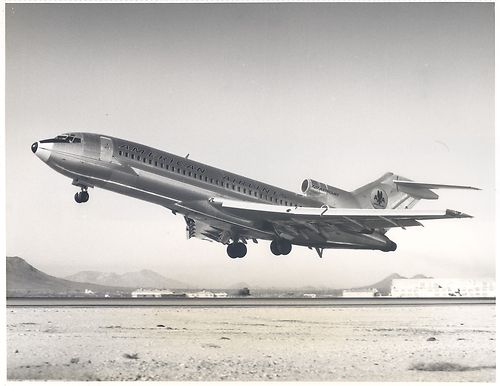
In the 1930s under the leadership of legendary Juan Trippe, Pan Am experienced phenomenal growth, crossing the oceans and hemispheres. Trippe’s vision connected the world, first with the Boeing flying boats known as “Clippers” then ultimately enormous Douglas piston liners, then jet travel in the 1950s. Trippe launched Pan Am’s own jet age with orders for Douglas DC-8s and Boeing 707s. Trippe ultimately chose the 707 for his massive growth plan, selling most of the DC-8s to United.

Pan American took airline travel to a stratospheric level of service with a seasoned professional staff with high standards and the best of amenities, with real “pie-in-the-sky” service. By the 1970s, Pan Am had transported 11 million passengers to 86 countries on all the world’s continents with the exception being Antarctica. Trippe’s goal was supersonic transportation to anywhere in the world. Increasing concern for the environment and Boeing’s increasing interest in volume market subsonic wide-body jet service sidelined Trippe’s plan, which also included space travel.

Any time Boeing Chairman Bill Allen heard from Trippe, it had to have put Allen on a diet of anxiety medication because he understood what hearing from Trippe meant. Trippe didn’t just dream – he dreamed big. At the cusp of the 1950s, Trippe wanted jets. Allen bet the entire worth of Boeing to develop the Jet Demonstrator – the 367-80, a four-engine jet transport known as the Boeing 707. Boeing used the “367-80” for its 707 designation to keep the jet demonstrator a secret.

Pan American launched Boeing 707 jet service across the Atlantic, the vast Pacific, and to South America as the 1960s unfolded, becoming “The World’s Most Experienced Airline,” and so it went.

Pan Am to the world.

A decade later, Trippe summoned Bill Allen for drinks and dinner. He advised Allen he wanted a really big plane with a capacity of 450 passengers that would cross oceans and do it great numbers. He also wanted it right away. Allen returned to Boeing with a plan he presented to Boeing product planners, engineers, and workers. These seasoned Boeing professionals became known as “The Incredibles.”

Boeing acquired massive acreage northeast of Seattle, Washington, at Everett and erected the largest building in the world under one roof to build its new double-decker, twin aisle, jumbo jet 747. The 747 prototype, Ship 1, was assembled in a building that was not yet completed.

Boeing’s new 747 “Jumbo Jet” alongside the Jet Clipper 707.

Pan American made the world smaller with its fleet of 707 and 747 jets. It merged with National Airlines in 1980, picking up National’s domestic routes to feed its international route map. It seemed the perfect marriage.

Time was not kind to Pan Am despite the National Airlines merger. Airline deregulation, coupled with the tragic Christmastime bombing of Pan Am 103 over Lockerbie, Scotland, doomed Pan Am to extinction in 1991. It could not overcome the financial losses. However, Pan Am paved the way to a smaller world and travel we could have only dreamed of 100 years ago.

The Lure Of The American Highway

American culture is best exemplified by the lure of the road – that wanderlust that inspires us to get behind the wheel. And – what a great place to wander. There isn’t one part of America that doesn’t inspire – well, maybe – there are some places that are just no place to be.

I believe there was a song from the late 1970s with the lyrics “Augusta, Georgia is just no place to be…” which doesn’t speak well of this Georgia peach though I think the songwriter didn’t quite mean it that way. I believe they closed their eyes and pointed at a map – or got a speeding ticket in Augusta and spent a night in jail.

When we were young, we had the energy and passion for travel. We were going to get the hell out of Dodge one way or the other and see the world. Gordon Lightfoot’s “Carefree Highway” presents this in music –

Carefree highway
Let me slip away on you
Carefree highway
You’ve seen better days
The morning after blues
From my head down to my shoes
Carefree highway
Let me slip away, slip away on you

The fictional “Carefree Highway” was, in essence, a metaphor – an escape – from the emotional pain of a lost love, a shattered dream, and leaving one’s discontent behind. The American highway was a means to escape – to slip away – with no idea where it would take you. It could also be considered the highway of hope.

People from around the world have aspired to come to America to see our vastness. We have some of the most incredible National Parks in the world. I’ve stood on the Southern rim of the Grand Canyon, and I’ve marveled at Monument Valley. Colorado and Wyoming offer a wealth of places that only the Rocky Mountains can offer.

I have been to Yellowstone and watched “Old Faithful” erupt, and I have stood on both coasts and watched both the sunrise and the sunset. I’ve driven out of Idaho west of Boise into Washington, heading toward the Tri-Cities, and been stunned at what I could see coming out of the mountains of Eastern Washington.

As mundane as the Midwest seems to a lot of people, it remains my most favorite place in the entire world. You can stand in Eastern Kansas and Nebraska and look across the flat lands as the sun sets and the storms coming. The Great Plains say so much because they are such an authentic part of America. The Great Plains yield a vastness unequaled.

There’s nothing quite like coming out of the high plains of Eastern Colorado and Western Kansas and being able to see for at least 100 miles to the horizon. Watching thunderstorms pop up on the horizon inspires us to observe the wonder of nature and the power of lightning.

There was a time when Americans didn’t have the wherewithal to travel great distances and have remained in their hometowns – never leaving the county. And would you believe I still know people who have never left where they grew up? They have never traveled and never had a desire to leave where they have been all of their lives. I cannot relate to how that must feel.

I’ve been in 49 out of 50 states. Thus far, North Dakota has had to do without me.

Soul Stirring Harry Chapin

When I was coming of age in the 1970s, a voice I so loved and still remember today is the late great vocalist Harry Chapin. His word invoked tears – humbling, sad – yet inspiring. You could call Chapin a beautiful soul. He was a singer, songwriter, a philanthropist, and a hunger activist. His work began to shine in the 1970s when a lot of us were coming of age. His words – his voice – moved us to tears.

Especially moving was a summer day in 1981 when we learned he was killed – rear-ended by a semi-truck when he was stopped on the Long Island Expressway. Concerned for his safety, he had turned on the emergency flashers and made a fateful lane change. He was struck violently from behind and did not survive.

A nation – a society – was driven to tears.

Chapin brought us 11 albums in the 1970s and continued recording until he passed. Some 14 of his singles became hits – with “Taxi” and “Cat’s In The Cradle” topping the charts. Soul-stirring music we listen to even today.

We listen. We cry.

Harry was a remarkable performer – yet he was so much more. He fought tirelessly to end world hunger – creating the Presidential Commission to end World Hunger back in 1977 – and was awarded the Congressional Gold Medal for his efforts. Most of his travels were efforts to end world hunger.

Chapin was a native New Yorker from Brooklyn Heights who came from a family of musicians. He began performing with his siblings and his father in his teens. He went on to achieve greater levels of education in the years to follow. It is my belief Chapin endlessly pursued efforts to make the world a better place.

As the 1970s unfolded, Chapin found himself in great demand – signing a multi-million deal with Elektra Records, which was considered one of the greatest recording deals of his time. His albums and singles rocked the charts with “Taxi” as a 25 Billboard Hot 100. Chpain became a force to be reckoned with worldwide. It is said top radio personality Jim Connors promoted this song, which kept it high in the charts for some 16 weeks.

When Chapin appeared on The Tonight Show with Johnny Carson, the phones at NBC rang off the hook, inspiring the show’s producers to have him back for a second night in a row. His music career took flight.

Because “Taxi” sounded like a true story, Chapin was asked if it was based on truth, he said, “It is emotionally true, if not literally…” Apparently, Chapin was at a low spot in his career when he heard a former girlfriend had gotten married. She wanted to become an actress but instead got married and went in a different direction. That’s when he spun that story into “Taxi” about a guy driving a taxi in San Francisco who picked up his former girlfriend as a fare. The message in the lyrics was they had both sold out their dreams. She was going to become an actress, and he was going to learn to fly. That led to “How are you, Harry?” and “How are you, Sue?” Immortal words that remain with each of us to this day. It evokes a mental picture we just can’t shake.

Harry Chapin touched so many lives in his brief period of fame. The same can be said for the late Jim Croce with “Time In A Bottle.” Both men left such deep impressions on so many. Whenever I hear their words, I weep.

Behold The Sunrise – And Another Day…

Many of us over the age of 60 lament the onset of old age. We complain about health issues and everyday aches and pains that come with the turf. We joke about old age, yet under the surface, we are afraid of the inevitable – the end of life.

However, consider this – you are still here to witness the sunrise.

I am reminded every day of my blessings. Yet – decidedly bummed over dreams lost. I suspect a lot of us feel this way. We have our regrets and lost dreams. This doesn’t mean we haven’t lived. Our everyday experiences – the pleasures and the pain – mean we have lived and very much alive to feel. It doesn’t mean you’ve gotten what you’ve wanted. It means you’ve been here to experience.

The late John Lennon once sang the words, “Life is what happens to you while you’re busy making other plans…” made famous in 1981 with “Beautiful Boy” (Darling Boy) in 1981. He spoke the truth. Day-to-day life gets in the way.

I’ve always viewed life as a series of chapters – phases. Each phase has been a story. Some good. Some not so good. When we were young, life stretched out ahead of us, with old age way off in the future. Had I known what was ahead of me, it would have scared the hell out of me. Life had a lot more in store. It would prove a toughening-up process. I would be unemployed, divorced, and an overnight father – wondering how to feed my children. However, I was handed a blessing – fatherhood.

Tough times made me stronger. I became a more responsible person.

I’ve lived through and survived frightening stages in life where the pain was so bad, and I didn’t have a friend in the world. Betrayed. Beaten. Scared. Alone. There was a time when I didn’t think I would survive – and didn’t care if I did. I was lying on a bathroom floor in the dark, searching for a way out. I heard my infant son cry in the next room and understood with great certainty that my destiny was to care for my son – no matter what. There was no other option but to care for my family.

That was 37 years ago.

Here’s what I learned from living through the lowest point in memory. You’re stronger than you think. You will survive if you are determined to survive, and especially if you have others who depend on you.

Survival is best taken in baby steps. It has been said you cannot eat an entire elephant in one sitting. It is best taken in manageable bites. When you’re at rock bottom and overwhelmed, you don’t even know how you will find your way back.

Are you listening?

Plan your work – and work your plan. Be prepared for missteps and poor judgment. You’re going to make mistakes and will probably have to work the plan all over again. Fake it until you make it – and then you will get it.

It is okay to flounder – but don’t make a habit of it. This is Earth School, not a dress rehearsal. We were born into this world to experience, learn, feel, and gain valuable knowledge for a higher purpose. We are not expected to understand that purpose.

The late great satirist, George Carlin, said we are part of a greater wisdom than we will ever understand. He couldn’t have been more correct. The man went through many ups and downs in his life. He was funny and entertaining. He stood back and took a broad brush look at humanity. However, Carlin was a humble man who took life seriously. He struggled with depression. He spoke of his wayward father with tears in his eyes and a lump in his throat.

The man who made us laugh understood pain.

If you are loved by someone – anyone – count your blessings. It means someone cares enough about you to feel love for you. You don’t need a huge circle of people – just one. Someone’s heart.

We do a lot of soul searching at this age. Is there still time to achieve our dreams and find happiness? When you are 60+, you begin thinking about your own mortality. Friends become ill and pass. Others die suddenly. These thoughts are nothing new. Mankind has been pondering its existence for thousands of years.

The joy of our advanced age is the wisdom and the good memories we have. We get together with friends and family in our age group and reflect on another day and time. We had our hopes and dreams – much as we still do today.

Our Addiction to Portable Electronics Began with the Humble AM/FM Radio

What did mankind do before portable handheld electronics? And, what on earth are we doing now? Seems you cannot go anywhere without seeing someone engrossed in a cell phone, laptop, or tablet. It has become epidemic in our homes, restaurants, and outings with friends. It has become the norm where you are pretty convinced a friend or loved one’s entire life has become virtual reality.

Whatever happened to reality?

For such a connected society, we’ve become the disconnected masses who’ve lost the human touch. Distraction instead of attraction. I admit to being affected. I’ve become so addicted to texting that I find it annoying when someone says, “Call Me…” What?! On a more personal level, I suffer from a profound hearing loss dating back to Air Force noise, which makes phone conversations challenging at best.

Still – there’s nothing quite like reaching out and touching someone.

Ever find yourself alone in a room full of people?

Friendships via electronics have become more common than friendships in person. How many of us have met via social media? We probably have more friendships from social media than we ever did in bars, school, work, or another form of human interaction. Friendships begin with a “reach out” instead of a handshake.

I look at the more personal touch we get from our pets. They walk up, tails wagging, licking your hands and face. They like that more archaic approach to relationships, face-to-face, hearing your voice instead of reading your words.

Most will argue this obsession with portable electronics is no big deal, but instead a new means to socializing. To me, personally, it’s a big deal. A deal breaker.

Rainy Days and Mondays…

It was a warm spring evening in my native Maryland in 1971. I was at a carnival like so many of us attended in those days – hanging with my buddies – seeing what kind of mischief we could get into between rides.

It was a fabulous time to be alive.

I was 15…

On the P.A. system was Karen Carpenter’s angelic voice and “Rainy Days and Mondays”— yet another Top 40 Carpenters hit that touched my soul like so many others. So many of us were touched by her voice and Richard’s incredible keyboard work. Although this song was bluesy and symbolic of rainy days and Mondays, it offered a sense of optimism and promise. It was refreshing to hear.

I was young, healthy, and very much alive. There was the aroma of fresh clover in the air, fresh-cut grass, and the feel of a fresh spring rain the night before. Warm weather and the end of school were just ahead.

It was impossible to go anywhere and not hear The Carpenters – yet they nearly never rose to fame. After several failed attempts to sign on with the record companies, they came into their own with a musician and record producer, Herb Alpert of A&M Records (Herb Alpert and Jerry Moss), who saw genius in their talent and signed them on in April of 1969.

Karen and Richard were involved in a Long Beach band known as Spectrum, which enabled them to refine their technique. When Spectrum folded, they worked feverishly with multi-layer (overdubbing) at a sound studio in Santa Ana. That was when they formed The Carpenters. A&M Records and huge fame swiftly followed.

Alpert quickly recognized The Carpenters’ abilities, especially Karen’s angelic voice, which was inspiring. He was so inspired that he gave them complete access to the A&M studio and the freedom to create their first record album. This opened the floodgates to an amazing run of hits, albums, and singles.

“For All We Know,” “Close To You,” “We’ve Only Just Begun,” and a string of others followed throughout the 1970s – great love songs that became of us as baby boomers coming of age. My mother kept walking through the door with a succession of Carpenters singles she’d play on our Magnavox AstroSonic console, which remains with me to this day in California. I recall the first time I heard “For All We Know” on her Magnavox amid a stack of 45s on the turntable. It inspired me to hear a chorus of Karen Carpenters from the Maggie’s tweeters and woofers in one of the most incredible overdubs I’ve ever heard.

To hear The Carpenters today triggers so many memories from our youth. I get such a rush of euphoria from their work – then return to the here and now at nearly 70, reflecting over the lifetime that has passed since.

Karen’s untimely death in 1983 was a huge shock for those of us who loved her and embraced her work. She really was an angel on loan to the planet for such a short time who will forever be missed.

How The Hell Did I Wind Up in L.A.?

Do you recall being young and naive – emphatically stating that there were things you were never going to do – ever? Then, found yourself doing these things? That’s my story, and I am sticking to it—wondering what happened.

I’ve been on Planet Los Angeles in sunny Southern California for 31 years. I still do not understand this place. “Big L.A.” was a place where I was never going to live – ever – not because I didn’t like the place, but because I did not know the place.

Being an East Coast boy with a lot of time spent in the American Heartland, I suppose I never will understand L.A. Los Angeles is not like the rest of the world, and that’s not necessarily bad. Why does L.A. have to be like the rest of the world?

Being from the East Coast and Midwest, my DNA is of these places. I love the Midwest for its genuine charm and incredible people. Watching the farm reports in Oklahoma, Kansas, and Missouri – and seeing weather reports and news stories with clearly pregnant newscasters in Illinois and Tennessee.

These folks, no matter their celebrity, are your neighbors and friends who become extended family. You help them move to their new house and run into them at the county fair. They are real and not too full of themselves. Having grown up in Washington, D.C., the news was always about politics and “Today on Capitol Hill…” And – like L.A. – D.C. has always been about gossip, scandal, and narcissism.

Having lived in many places and having visited 49 out of 50 states, I’ve pretty much seen it all – yet I really haven’t seen diddly. My career as an automotive journalist brought me to Los Angeles more than three decades ago. I arrived for the first time in 1990 as a feature editor with Car Craft Magazine. I worked in the old Screen Actors Guild building, a mid-century modern box on stilts along Sunset Boulevard. This dusty old building was “as built” in the 1950s, with old, wrinkled, dirty, stained carpeting and completely original black and white tiled restrooms with black open-front toilet seats. I’d sit on the mid-century “Standard” toilet thinking, “Ronald Reagan actually sat here…” Ditto for urinals that lined the tiled walls – thinking of the hordes of male celebrities who’d stood there.

Walking into that building and working on Sunset in Hollywood was culture shock for a young buck like me. It was a far cry from the American Heartland and East Coast I’d long been accustomed to. I was suddenly having lunch with editorial celebrities I’d read about in Hot Rod, Car Craft, and Motor Trend. We would sit down to breakfast nearby with Candid Camera’s Alan Funt. It was a dreamy, yet disorienting experience. I felt completely out of place.

How on Earth did I get here?!

I didn’t know it then – but I was here for the rest of my life. I had a five-year plan – to get the experience I needed, then return to the heartland, secure an editorial job, and live out my life. The Midwest was where my dreams were. However, Life had other plans for me. It isn’t that L.A. is a bad place or one big freeway, it is the difference in culture I witnessed at the time that – somehow – became the norm.

I must remember to add North Dakota to my bucket list.

I’ll have my guy call your guy and we will do something – “later…”

Life Launch – What a Great Idea

What have we taught our young – our kids, grand kids, and even great grand kids? I’d really like to know. We judge young people for their patterns, trends, and priorities – but what have we really taught them anything?

Anything?

I blame parents and I blame education. How much time have you ever spent teaching your kids how to launch and how to survive? Baby Boomers have a lot to answer for here because too many young people don’t know how to fill out a job application, write a check, put a stamp on an envelope, or check oil in a car.

There’s a legitimate reason for this.

Boomers birthed the latch-key generation – which came as a result of working couples being gone most of the day. Dual incomes, two cars, vacation homes, day trading, gourmet ice cream, five bedrooms and three baths, luxury cruises, and a whole lot else – stuff we didn’t really need.

The Greatest Generation not only handed us the benefits of a prospering economy and a free society, but they also made us hunger for more. We’ve just had to have it all – meaning we haven’t lived within our means. We are the credit generation, drowning in perpetual debt.

I believe our parents and mentors wanted us to have it better than they did. But did they also inspire us to want more? Maybe they gave us a little too much.

I also know they taught us how to survive as did education. We were taught how to write in cursive, fill out a check and manage a bank account, how to fill out an application, clean up after a meal, empty the trash, and how to operate a clothes washer. We entered the adult world ready. Not all of us have scored well.

Why do so many young people today not know how to go forth and survive? They don’t understand what is needed to survive and be successful – stuff we take for granted in ourselves because we were taught these skills as we came of age. Most of us automatically know how to write a check, clean up the kitchen and scrub a toilet, fill out a job application, apply a postage stamp to a letter, take medication, vote in an election, and know to lock a door when we leave the house.

Education was a broader spectrum in those days – teaching the trades, home economics, math skills, auto shop, physical education, art class, history in much greater detail, sociology, and how to clean up after ourselves. Leaving a mess behind was never acceptable and there were real consequences if we did. When it was time to learn how to drive, there was Driver’s Education – and consequences if we broke the law and got a ticket.

Accountability…

Does anyone born beyond the 1980s know anything about World War II, Korea, or Vietnam? What about the assassinations of the 1960s – JFK, RFK and Dr. King? What about the music sensations of our time – The Beatles, Herb Alpert, Tony Bennett, Andy Williams, Elton John, James Taylor, or The Rolling Stones? It is remarkable how much we haven’t shared with our young.

I firmly believe electronics and social media have created a disconnect we will likely never emerge from. We are all caught up in it. Everywhere you go, there’s someone immersed in a cell phone or tablet. This, in and of itself, has spawned a disconnect that has both connected and divided society.

America On the Edge in 1962

Never has the nation been more on edge than it was in October of 1962 when we were the closest we have ever been to nuclear war. The Cold War between the Soviet Union and the United States had never been colder than when the two countries took part in a 13-day standoff sparked by the US placement of nuclear missiles in Italy and Turkey, and the Soviet response with planned nuclear missile placements in Cuba.

It was a decidedly complicated mess spurred the placement of Jupiter nuclear missiles in Italy and Turkey by the US along with an effort to overthrow Cuba. The effort to overthrow Cuba was an ongoing effort where tensions continued to be high and Cuba needed support.

The Soviet Union, concerned most about Cuba forming an alliance with China, began focusing more and more on Cuba. This led to a meeting between Soviet Prime Minister Nikita Khruschev and Fidel Castro in the summer of 1962. They agreed to position nuclear missiles on Cuba to fend off a potential US invasion.

Though it appeared to be a mutual agreement between Khrushchev and Castro, it is also true Fidel didn’t want Soviet nuclear missiles on Cuban soil. It was increasing pressure from Khrushchev that led to this agreement and concern over consequences from the United States.

When the Kennedy Administration caught wind of the missile placement, a meeting occurred between President Kennedy and his National Security Council along with members of his cabinet. A decision was made to attack Cuba from the air followed by an invasion to cripple Soviet missile placements.

This plan was not going to be.

President Kennedy instead chose a safer more conservation decision – staging a naval blockade in the Atlantic to prevent missiles from reaching the Cuban mainland. The Cuban Missile Crisis ensued that October, which ultimately led to the Soviet Union removing its weapons from Cuba. By the same token, the United States agreed to remove nuclear weapons from Italy and Turkey.

The Cuban Missile Crisis was a lesson in compromise, which prevented all-out nuclear war – something we’d do well to try today. During the 13-day standoff with the Soviet Union and Cuba, Americans suffered from nervous stomach, wondering what was next.

My father was a career cryptologist and a US Navy Veteran with the National Security Agency at the time. He went to work and didn’t come home for nearly two weeks with not a word, which made my mother nervous.

I was but five years old at the time so I must admit I didn’t know much about it. All I knew was he didn’t come home for two weeks, assuming he was on a business trip. In truth, he was out at NSA’s headquarters at Fort Meade, Maryland – unable to communicate with the outside world.

Sometimes, the tension was closer than we thought.

What most didn’t know amid the embarrassment for Khrushchev was a secret deal between both Kennedy and Khrushchev where the Soviet Union agreed to pull back from Cuba from the effort they had created. This led to Khrushchev’s eventual fall from power as a result of this embarrassing turn of events. Khrushchev blundered in this agreement with the United States and came out with egg on its face.

US President John F. Kennedy and Soviet Prime Minister Nikita Khruschev

The good news in all of this was improved communications and negotiations between the US and the Soviets in the years to follow. Though Khrushchev saw Kennedy as weak as a result of the failed Bay of Pigs invasion, Kennedy came out on top in time. Ultimately, the US and the Soviet Union found a fragile path to peace though the threat never went away.

The Cuban Missile Crisis reminds us of just how fragile our freedom and liberty are and that we must never take these elements for granted. We learn from this just how important clear and concise communications is between the world’s superpowers. The Cuban Missile Crisis – and others – show us how easy it is to misunderstand intent versus what the other guy is actually thinking.

An Accurate Portrayal of American Life?

The American Way in the 1950s….

How we perceive our past through dozens of mid-century documentaries and their portrayal of American life in the 1950s and ’60s is enlightening. We watch, record them, and reflect fondly upon another time.

Most of these films were “Chamber of Commerce” productions made in an effort to sell “the American way…” or to promote a product or service. Defense contractors have always been big on documentaries. However, what was the “American Way” exactly? I suppose it depends on who you speak with and what they remember.

As boomers in our twilight, we don’t always remember history as it actually was. Times were good for a lot of us—but not all of us.

During the post-war boom, the only way was up. We were rising from rough times, aiming for space dominance and the Moon. With help from our allies, we’d won a world war in two theatres a vast distance apart. We had achieved an impossible task – with thousands of war wounded and dead. It was time to heal.

In retrospect, I have to wonder how we did it.

We did it because we decided to do it. It was a collective undertaking, and it was everything to save the world from tyranny. Life has always been a battle between good and evil. Sometimes, good and evil become blurred.

As boomers growing up in the ‘burbs, we didn’t have to face the issues our parents and mentors did. Our parents had endured the Great Depression and World War II. The post-war years were no picnic either, despite what our world might have looked like through a camera lens and a narrator.

I believe we had more class in those days before travelers started wearing torn blue jeans and tee shirts on airliners and in trains. I credit boomers for making society too casual. This happened during the hippie movement in the 1960s. Formal attire got sidelined for clothing that had been lying on the closet floor for a week.

Maybe I sound really old, but I don’t get young people traveling in pajamas. That’s the latest trend I see everywhere. It implies the absence of motivation. I won’t even get into body piercings and some really tasteless tattoos.

War Vets must look at us and wonder what they were fighting for. Forgotten Vietnam War Vets hear “Thank You for Your Service…” everywhere they go, yet where is the love, man? The most forgotten segment of our society is war Veterans, wondering where they fit in and where true gratitude is.

We are big flag-wavers, but not much on substance. Vets need real action.

I will always tend to wonder who we really are as a nation and a society. The late comedian and satirist, George Carlin, said it best when he said “America is about the marketing and distribution of bullshit…” We have some of the best marketing people in the world who’ve always been good at selling the “American Way” worldwide.

America has become tarnished, narcissistic, and disconnected. Yet, I see hope in some factions genuinely interested in putting us back together. I believe in America. I also believe we are a work in progress, much as we have been for 249 years.