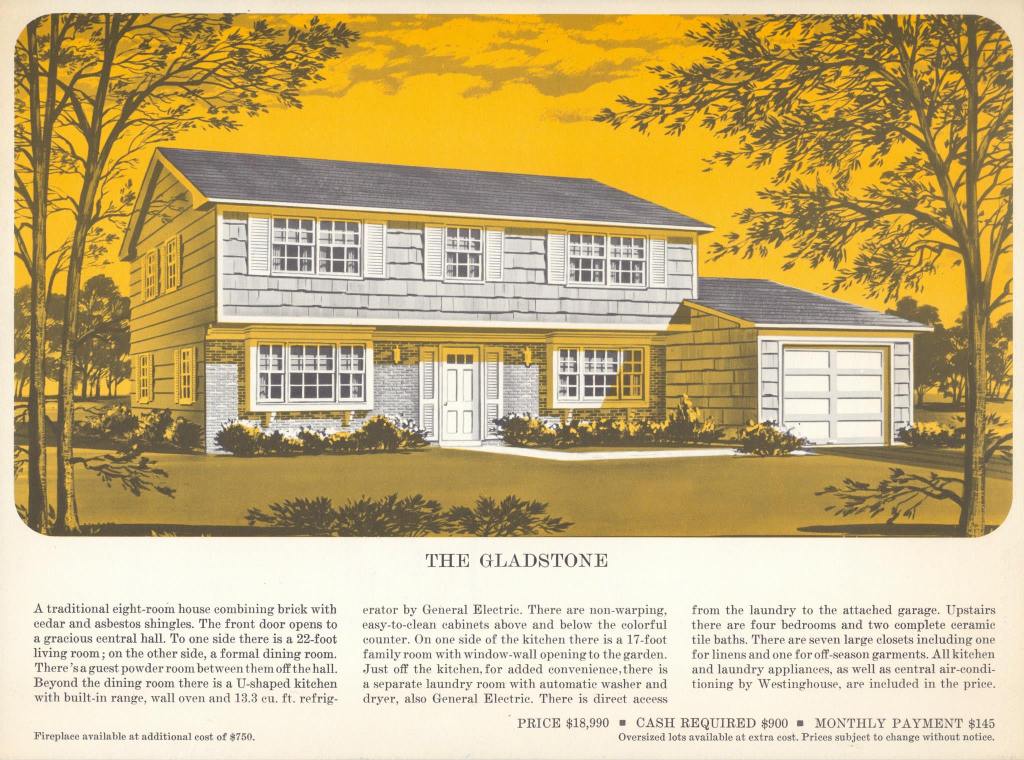
Announcing the passing of a great American pastime – the touring of new model homes…
Does anyone do this anymore?
Walking through model homes was on a par with going to an amusement park or a drive to the beach. It was just something we did on the weekends as a family. It allowed us to dream. It was euphoric.
We wondered…what would it be like to live in a new home?
New homes yielded the aroma of oil-based paints along with the gassing off of plastics and new carpet. We didn’t understand then the hazards of what we were breathing in – including asbestos.
Model homes, of course, were never realistic for most of us. They had mid-century modern display furniture and were homes fitted with all of the desirable options people wanted like the best kitchen cabinets and appliances, upscale bathroom counters and ceramic tile, carpeting, high-end light fixtures, and finished basements. These were all elements dreams were made of.
Because developers didn’t want you defecating in their potties, there was plywood installed between the toilet seat and bowl to keep people honest. Developer Levitt & Sons, as one example, placed a rope across the doorways to keep people out of the bedrooms. Levitt also placed a large chunk of Plaster of Paris in the toilets to prevent people from doing the naughty in its bowls.
When I was a kid, touring model homes was the only thing my family ever did together. We never went to the beach or down to D.C. to tour the Smithsonian. We drove to Arlington to see my grandparents or “up home” to Greenwich, Virginia to see the relatives on my mother’s side. That left touring model homes as a nice place to dream and pretend with. It gave us hope.
Today, young people are so wrapped up in electronics to where virtual reality seems to be better than the reality of walking through new homes. What I loved most about new homes in the 1960s was walking through homes under construction to see how houses were constructed. It became a passion for me. I wanted to be an architect. When I discovered I was really bad at math, I had to choose another occupation entirely.

I loved the bones of a house under construction – where the plumbing and electrical went, heating and air conditioning, and guessing at where everything would ultimately go. I grew up in the Belair At Bowie, Maryland community just outside of Washington, D.C. which was Levitt’s first community outside of the Northeast. It was also Maryland’s first Levitt community. It was an amazing place to watch grow out of the rural Maryland soil. And, for nine years, Levitt & Sons built more than 9,000 homes some 26 miles outside of Washington.
When we moved to Belair from Laurel, Maryland in 1965, it was an opportunity to wander the homes under construction. Levitt continued building across the Maryland countryside until it ran out of land. For a kid like me, it was pay dirt because I wanted to know all about home and building construction. Levitt & Sons provided the education.
Aggressive housing construction continued well into the 1970s with baby boomers and Gen Xers coming of age. It was a target rich environment for developers and growing families alike. It was also very competitive. Not all developers would survive, including Levitt & Sons, which was the one to beat in the post-war years. When Bill Levitt sold out to ITT in 1967, this created a downward spiral for the Levitt name and Mr. Levitt himself. Because Levitt took the ITT deal mostly in stock options, he lost his wealth to declining ITT stock.
Levitt was never able to regain traction as a home builder. He died broke in 1994 at age 86. A good many home builders from the mid-20th century did not survive in the decades to follow. Savvy developers found the means and resources to keep going – many of which are still with us today.
 Boomer Journey...
Some builders were responsible for a subdivision and went dark, or became contractors for another developer. The Plat map of where I grew up has chunks of the neighborhood(s) named after the developer. Smith NW, Jones Park… We didn’t care because we’d troll the frames for electrical box knockout slugs on the urban myth pretense that they could be used in vending machines🤣 plus there were always sand piles worth climbing, using for bike ramps or hiding behind for whatever us vs them game was afoot. I also grew up in my Uncles’ lumberyard and all the assorted lumberyards my father called on. My summer jobs were always in some kind of home construction. I was shocked when at 16 I worked at a small local prefab plant building walls and trusses (on tables), stacking them in a fork-liftable pile to for Bureau of Indian Affairs houses. Two of us on a table built them a lot faster and probably more accurately than stick framers.
LikeLike
Good story Phil. We move into new homes and have no idea how they happened. Levitt & Sons had a subsidiary named Builders Supply Corporation. In Bowie, Maryland, Builders Supply Corporation was a huge construction yard and a gigantic metal building where house kits were assembled and shipped to the lots. Framers would march in one by one and turn kits into houses. In the yard was everything imaginable including piles of light poles, stacks of lumber, you name it. When Levitt wrapped up Belair At Bowie, the yard was shut down and cleared. The metal building was donated to the City of Bowie. All so long ago in 1970.
LikeLiked by 1 person
I worked on the BIA houses twice. Once in 70, again in 73 or 74. One was a summer job, the second lasted a summer until the truss and wall buildings caught fire. Which to this day I believe was the easiest way for them get out of the prefab house business.
LikeLike