Never has the nation been more on edge than it was in October of 1962 when we were the closest we have ever been to nuclear war. The Cold War between the Soviet Union and the United States had never been colder than when the two countries took part in a 13-day standoff sparked by the US placement of nuclear missiles in Italy and Turkey, and the Soviet response with planned nuclear missile placements in Cuba.
It was a decidedly complicated mess spurred the placement of Jupiter nuclear missiles in Italy and Turkey by the US along with an effort to overthrow Cuba. The effort to overthrow Cuba was an ongoing effort where tensions continued to be high and Cuba needed support.
The Soviet Union, concerned most about Cuba forming an alliance with China, began focusing more and more on Cuba. This led to a meeting between Soviet Prime Minister Nikita Khruschev and Fidel Castro in the summer of 1962. They agreed to position nuclear missiles on Cuba to fend off a potential US invasion.
Though it appeared to be a mutual agreement between Khrushchev and Castro, it is also true Fidel didn’t want Soviet nuclear missiles on Cuban soil. It was increasing pressure from Khrushchev that led to this agreement and concern over consequences from the United States.
When the Kennedy Administration caught wind of the missile placement, a meeting occurred between President Kennedy and his National Security Council along with members of his cabinet. A decision was made to attack Cuba from the air followed by an invasion to cripple Soviet missile placements.
This plan was not going to be.
President Kennedy instead chose a safer more conservation decision – staging a naval blockade in the Atlantic to prevent missiles from reaching the Cuban mainland. The Cuban Missile Crisis ensued that October, which ultimately led to the Soviet Union removing its weapons from Cuba. By the same token, the United States agreed to remove nuclear weapons from Italy and Turkey.
The Cuban Missile Crisis was a lesson in compromise, which prevented all-out nuclear war – something we’d do well to try today. During the 13-day standoff with the Soviet Union and Cuba, Americans suffered from nervous stomach, wondering what was next.
My father was a career cryptologist and a US Navy Veteran with the National Security Agency at the time. He went to work and didn’t come home for nearly two weeks with not a word, which made my mother nervous.
I was but five years old at the time so I must admit I didn’t know much about it. All I knew was he didn’t come home for two weeks, assuming he was on a business trip. In truth, he was out at NSA’s headquarters at Fort Meade, Maryland – unable to communicate with the outside world.
Sometimes, the tension was closer than we thought.
What most didn’t know amid the embarrassment for Khrushchev was a secret deal between both Kennedy and Khrushchev where the Soviet Union agreed to pull back from Cuba from the effort they had created. This led to Khrushchev’s eventual fall from power as a result of this embarrassing turn of events. Khrushchev blundered in this agreement with the United States and came out with egg on its face.
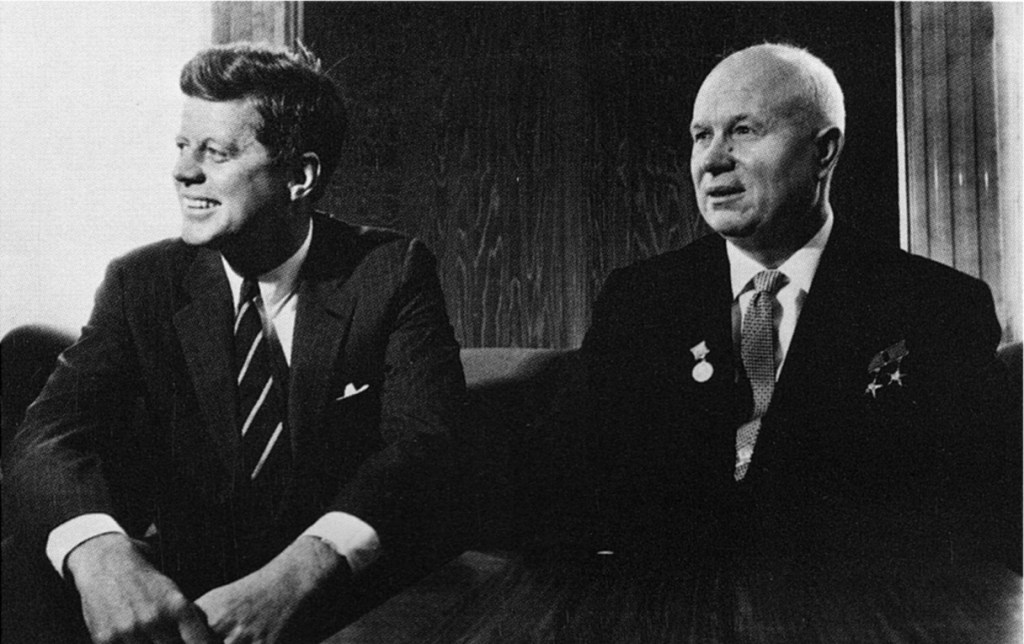
US President John F. Kennedy and Soviet Prime Minister Nikita Khruschev
The good news in all of this was improved communications and negotiations between the US and the Soviets in the years to follow. Though Khrushchev saw Kennedy as weak as a result of the failed Bay of Pigs invasion, Kennedy came out on top in time. Ultimately, the US and the Soviet Union found a fragile path to peace though the threat never went away.
The Cuban Missile Crisis reminds us of just how fragile our freedom and liberty are and that we must never take these elements for granted. We learn from this just how important clear and concise communications is between the world’s superpowers. The Cuban Missile Crisis – and others – show us how easy it is to misunderstand intent versus what the other guy is actually thinking.
 Boomer Journey...
And yet today telling a jerk with his hand out to hit it is bad form. JFK and Nikki slammed down phones, beat on a podium with a shoe — In the end the sh*t show was for the press. The good news, as stated, was Kennedy couldn’t figure out how to invade a tiny island and Khruschev backed down. No one wins a nuclear war. I keep waiting for Putin or North Korea to do something really stupid, but so far they haven’t. If the US ends up with a stake in the future of at least part of a free Ukraine, ie rare earth minerals, the whole scenario changes. Crazy. Remember bomb drills? Go out in the hall, duck and cover? Sheeesh…
LikeLike
We will never know all of it. Duck and cover…..like a school desk would he protected us.
LikeLiked by 1 person
🤣
LikeLike