
When you’ve been walking this apple for as long as most of us, you’ve witnessed a lot of change and growth in a lifetime. Good constructive growth is a wonderful thing when it is for good. Suburban sprawl was a good idea in the wake of World War II, when returning Veterans needed home and hearth for their families. They also needed safe and stable communities in which to raise children.
Responsible developers planned and built well thought out communities that have prospered and remained nice places to live. Others haven’t fared so well. Success or failure has depended largely upon local government as well as community standards and responsible homeowners. Despite the best intentions of developers, some communities have turned into suburban slums while others have experienced uncontrolled growth to where they’re no longer tolerable places to live.
I cannot think of a better example of runaway growth than Arlington, Virginia across the Potomac River from Washington where growth has turned a once “small town” suburb into a congested metropolis within a metropolis. The treelined streets I grew up with more than 60 years ago have become concrete and glass buildings beginning at Rosslyn stretching for miles out to Clarendon and Ballston.
I remember a different post-war Arlington.
Close into Washington in the heart of Arlington, my grandfather took me to the Royal Lee Delicatessen for a burger, then a root beer float at the soda bar in Drug Fair. I was introduced to the English Muffin by my grandfather at the Arva Motel restaurant long before it became a Day’s Inn. The Lee Shopping Center where these memories took place is gone, replaced by high-rise condos
My little hand was placed in his as we walked the streets of Arlington. We took long walks to nearly everywhere in Arlington from Courthouse out to Ballston. Being a man of faith, he’d take me to a number of churches along the way. My grandmother would take us to the Safeway and the Lee Super Market. Grocery boys bagged our purchases and would bring them to the apartment.
Bergman’s Laundry would roll up in front of our apartment building to deliver dry cleaning. Whenever I see a classic Checker Marathon taxicab, I think of Arlington and our rides to the doctor’s office or Kann’s Department Store in Clarendon. J.C. Penney’s was but a store front in the heart of Clarendon along Wilson Boulevard.
My how times have changed.
In those days, you could walk the streets and visit with local merchants. There was room to breathe, and it seemed everyone knew my grandparents. My grandfather, retired police Lieutenant Paul W. Proctor, who spent a career with the Metropolitan Washington Police Department, and later White House Police (now Secret Service). He served under several administrations, wrapping up with Harry Truman in 1947 when a heart attack ended his career. My grandparents retired to Arlington to a two-bedroom apartment made possible by the Federal Housing program enacted at the cusp of the 1940s. This program created housing for the growing federal workforce.
Rosslyn, Clarendon and Ballston were streetcar stops along Wilson prior to the 1960s. As the Metro transit system took hold, growth became a runaway – exploding into high-rises and office complexes. Quiet residential neighborhoods and store fronts were transformed into miles of glass and concrete. The buildings and storefronts I knew as a child are gone today. Ironically, some remain, including a Little Tavern Hamburgers building turned pizza joint on Wilson Boulevard.
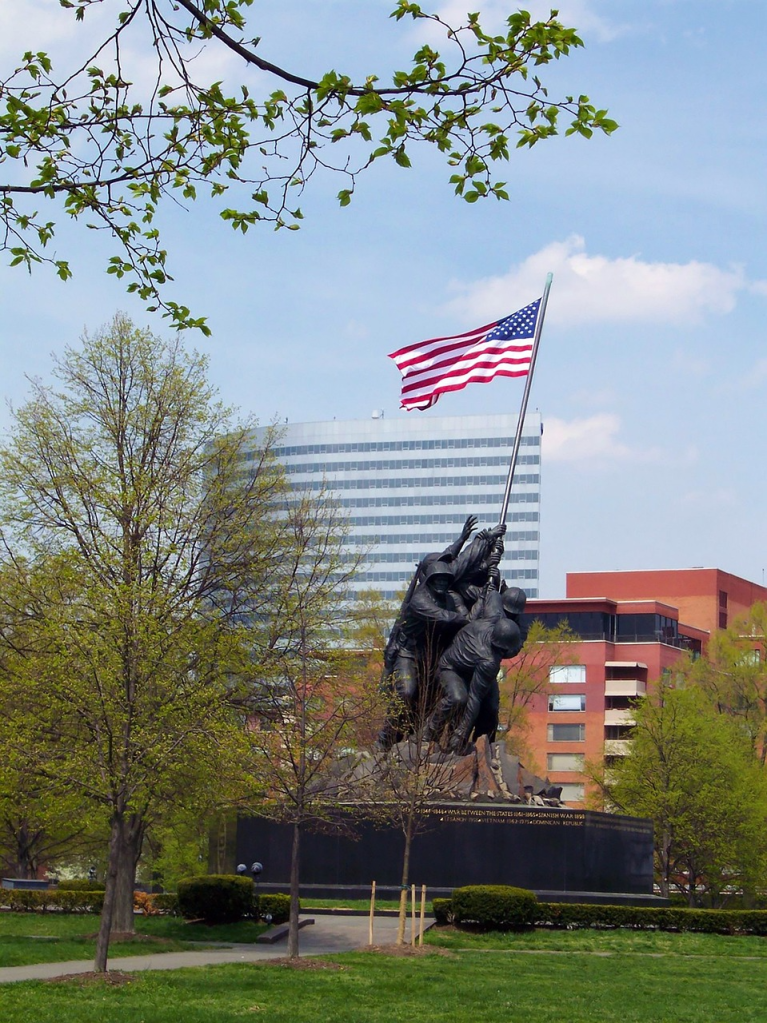
The U.S. Marine Corps Iwo Jima Memorial erected in 1954, with River Place rising in the background overlooking the Potomac and Washington. The Rosslyn skyline today dwarfs the once dominate River Place.
I suspect most of you have watched your communities evolve from rural to metropolitan since the 1950s. The mid-20th century was a period of unprecedented growth as the demand for housing and commercial space grew. Every metropolitan area will have a similar story.
What about the community where you grew up?

